Resale vs. New Build: Why Thailand's Secondary Condo Market Defies American Expectations — And When It Finally Pays Off
For most Americans who have bought and sold property at home, the calculus of resale versus new construction feels familiar. Resale properties come with established neighborhoods, known maintenance histories, and prices already adjusted for depreciation. New builds, by contrast, carry a premium for untested quality and the risk of developer delays. In Thailand, however, this logic largely inverts — and investors who fail to recognize that inversion often find themselves holding an asset that quietly underperforms for years.
Why the Western Playbook Breaks Down in Thailand
The Thai condominium market operates on a set of buyer preferences that differ fundamentally from those in the United States. Thai domestic buyers — who represent the majority of purchasing activity in most urban and resort markets — place exceptional value on newness. A freshly delivered unit with contemporary finishes, modern building management systems, and a full suite of amenities commands a psychological premium that has little equivalent in American markets. When that same unit enters the resale pool five or seven years later, it no longer carries that premium, even if it has been impeccably maintained.
This dynamic creates what might be called a structural headwind for resale sellers. The buyer pool for a used unit is narrower, the negotiating leverage tilts toward the purchaser, and the unit must compete not just against comparable resale properties but against new developments offering pre-completion pricing, developer incentives, and the allure of a building that has never been lived in.
The Amenity Depreciation Problem
Beyond buyer psychology, there is a concrete financial issue: amenity obsolescence. Thai condominium developments built even a decade ago were designed around a different set of expectations. Co-working spaces, EV charging stations, smart home integrations, and resort-grade rooftop facilities have become standard in projects delivered since roughly 2018. Older buildings, regardless of how well they were constructed, simply cannot retrofit these features without prohibitive cost.
For American investors accustomed to underwriting property based on structural condition rather than amenity currency, this can be a blind spot. A unit that appears sound by inspection standards may still be functionally obsolete in the context of Thai renter and buyer expectations. The result is compressed rental demand and a ceiling on achievable rents that newer buildings in the same submarket do not face.
Maintenance cost trajectories compound this challenge. As buildings age past the ten-year mark, sinking fund balances — the Thai equivalent of HOA reserves — often prove insufficient to cover major capital expenditures. Elevator replacements, pool resurfacing, and façade repairs fall to owners through special assessments. American investors unfamiliar with Thai juristic person governance structures are frequently surprised to discover that these assessments can arrive with limited notice and little recourse.
Layout Misalignment with Contemporary Demand
Floor plan design in Thai condominiums has evolved considerably over the past fifteen years, driven by the rise of the short-term rental market and the preferences of younger urban professionals. Earlier projects often feature layouts optimized for long-term family occupancy: larger bedrooms, smaller living areas, and kitchens designed for actual cooking. Contemporary renters and buyers in Bangkok, Phuket, and Chiang Mai increasingly prefer open-plan studios and one-bedroom units with generous living and dining space, compact kitchens, and balconies oriented toward views rather than utility.
A resale unit built to older specifications may be perfectly livable but difficult to position competitively in a rental market where comparable new inventory sets the standard. Gross yield calculations that look reasonable on paper can erode significantly once vacancy rates and concessions are factored in.
When Resale Properties Actually Outperform
None of this is to suggest that the Thai secondary market is without merit. There are specific, identifiable conditions under which resale condos not only compete with new builds but demonstrably outperform them. Recognizing those conditions is the discipline that separates opportunistic investors from those who simply absorb the structural disadvantages described above.
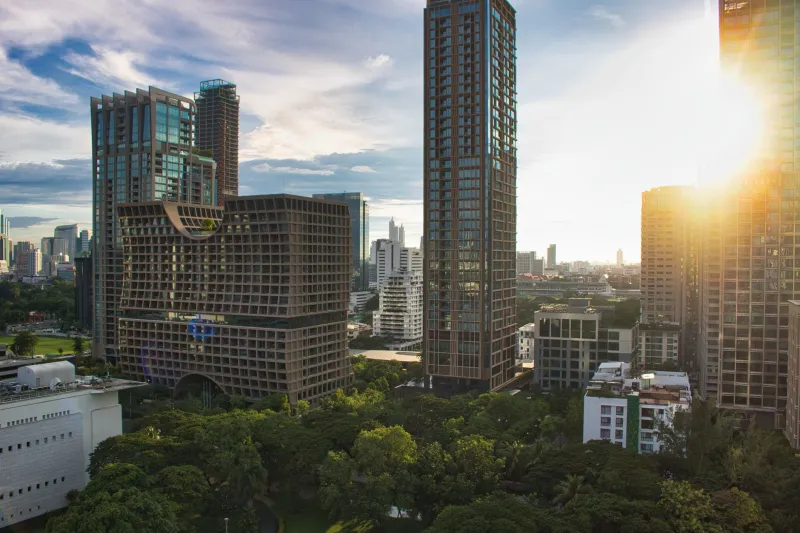
Established location advantage. In Bangkok's most supply-constrained corridors — certain stretches of Sukhumvit, the Silom-Sathorn axis, and select riverside addresses — older buildings occupy land that new developers cannot access at comparable cost. A well-maintained resale unit in one of these locations benefits from an irreplaceable geographic premium that no amount of new amenity spending can replicate.
Post-distress pricing. The Thai secondary market periodically surfaces units priced well below replacement cost, typically from sellers facing liquidity pressure, estate settlements, or currency-driven urgency. These situations — which require patience and local sourcing relationships to identify — can produce entry points that absorb the structural disadvantages of resale and still generate competitive returns.
Foreign quota availability in sought-after buildings. Thailand's 49% foreign ownership cap creates a secondary dynamic in which well-regarded older buildings sometimes offer foreign quota availability that newer, more heavily marketed projects have already exhausted. For American buyers who require freehold title, an older building with available foreign quota in a prime location can represent genuine scarcity value.
Buildings that have completed major capital cycles. Counterintuitively, a building that has already passed through its first major capital expenditure cycle — elevator replacement, common area renovation, pool and façade work — may present lower forward maintenance risk than a building approaching that cycle for the first time. Buyers who can verify completed upgrades through juristic person records are acquiring a more predictable cost profile than the raw age of the building suggests.
A Framework for Secondary Market Evaluation
Approaching Thai resale condos with discipline requires a structured evaluation process that goes beyond what most American investors apply in their home markets. Four questions are worth anchoring any analysis:
First, what is the amenity gap between this building and the newest competitive supply in the same submarket? If that gap is material and growing, the structural headwind is real and should be priced accordingly.
Second, what is the juristic person's financial position? Requesting the building's sinking fund balance, recent meeting minutes, and any pending special assessments is not optional due diligence — it is the minimum threshold for informed underwriting.
Third, what is the foreign quota status, and does it create scarcity value or a constraint? In some buildings, the remaining foreign quota is itself a negotiating tool; in others, a saturated quota creates a buyer universe limited almost entirely to Thai nationals, which depresses resale pricing.
Fourth, what is the seller's motivation? In a market where distress-driven pricing creates the most compelling resale opportunities, understanding why a unit is available is often more important than analyzing what it is worth at current asking price.
The Discipline Required
The Thai secondary condo market is not a space that rewards casual participation. The structural advantages enjoyed by new developments — developer marketing infrastructure, pre-completion pricing incentives, buyer psychology, and amenity currency — mean that resale properties must compensate through price, location, or circumstance to generate equivalent returns. Most do not.
For American investors with the patience to identify the exceptions, however, the secondary market offers something the presale pipeline rarely can: assets priced against reality rather than aspiration. That distinction, properly understood and systematically pursued, is where durable investment returns are built.